Most loan officers have been ignoring SEO for years. Too much work, too little return -- or at least that's how it felt before AI made content production fast enough to actually be worth it.
HighLevel now has a built-in AI blog writer. If you haven't used it yet, here's exactly what it does, how to use it, and the prompts that produce clean, publishable mortgage content -- based on real usage, not theory.
Quick Answers
Does HighLevel have an AI blog writer?
Yes. HighLevel includes a built-in AI blog writer accessible from any sub-account's Blog section. It generates a full post (1,000-1,500 words), title options, meta description, excerpt, tags, and a featured image from a single prompt. No additional subscriptions required.
What AI model does HighLevel's blog writer use?
HighLevel's Ask AI feature runs on Anthropic's Claude Sonnet. As of early 2026, the platform updated its core AI to Claude Sonnet 4.6.
Is mortgage SEO worth it for loan officers?
Yes -- especially now that AI tools make content production fast enough to be sustainable. Borrowers who find loan officers through organic search are typically in active research mode and convert at higher rates than cold paid leads. The compounding nature of organic traffic makes consistent blogging a strong long-term investment.
Why This Matters Now
SEO has always been a good idea for loan officers. The problem was the effort. A well-researched 1,000-word blog post used to take 3-4 hours to produce. That math never worked for a busy LO.
AI changed the calculation. The same post now takes 15-20 minutes with the right prompt and a basic editing pass. That's a sustainable pace.
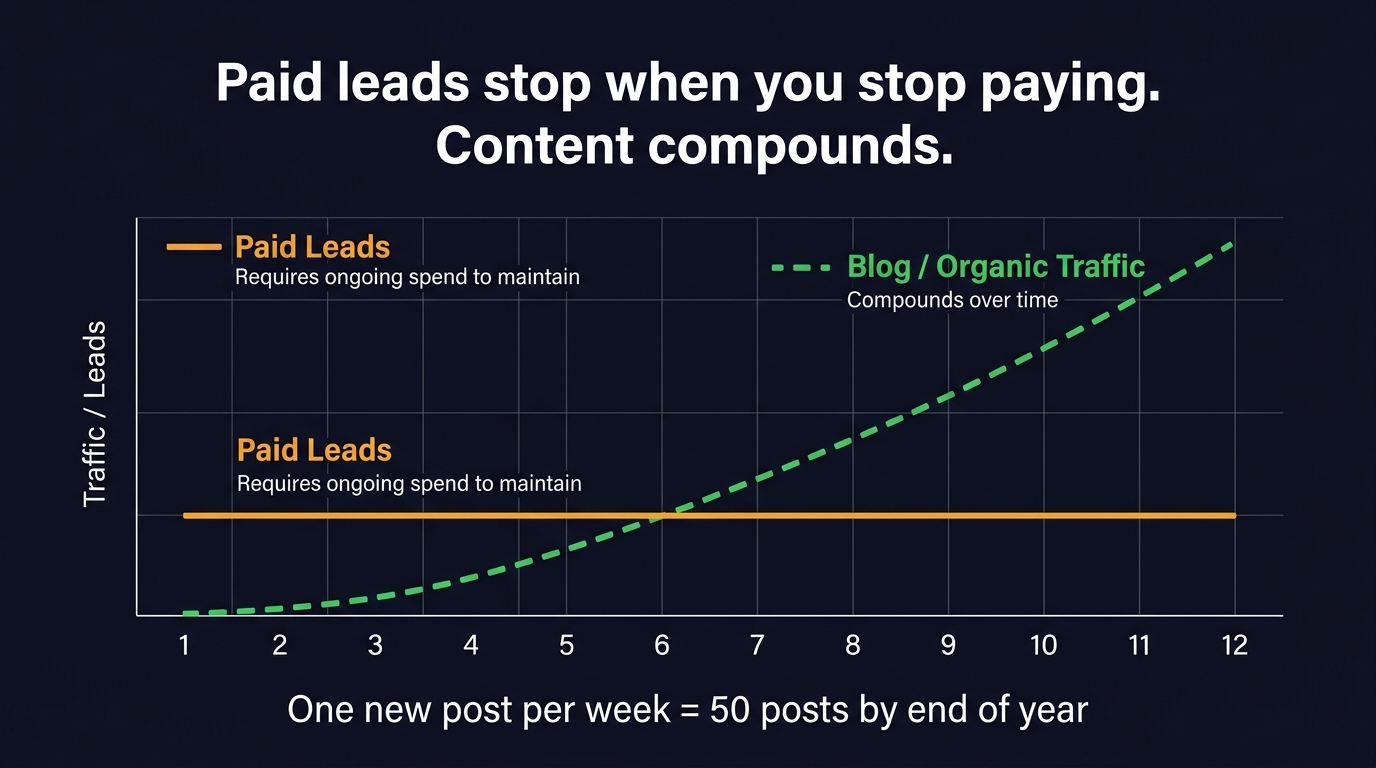
Most loan officers still haven't made this switch. The LOs who start now will have a compounding library of 50-100 blog posts by end of year. The ones who wait will be playing catch-up against people who started in January.
What HighLevel's AI Blog Writer Does
The tool is built directly into the platform -- no third-party integrations, no extra cost. You'll find it inside your sub-account under Websites → Blog → Create New Post → Generate with AI.
Here's what it handles automatically from a single prompt:
- Full blog post draft (1,000-1,500 words, formatted with headers)
- Title options (multiple variations to choose from)
- Meta description (auto-generated, SEO-optimized)
- Excerpt (short version for blog feeds and email snippets)
- Category and tag suggestions
- Featured image (AI-generated; quality varies -- see caveats below)
The writing quality is notably stronger than earlier AI blog tools. Running on Claude Sonnet, the output reads like a human wrote it -- not a content farm. With a good prompt, the draft typically needs light editing, not a rewrite.
The Prompt That Works
Output quality is almost entirely determined by the quality of the input prompt. Here's the format that consistently produces strong mortgage content:
Prompt Template
Write a blog post about [specific topic or question].
Audience: [consumers / real estate agents / loan officers]
Word count: 1,000-1,500 words
Tone: [professional / conversational / educational]
Include: [specific points, scenarios, or calls to action you want]
Tested example prompt:
"Write a blog post about when it makes sense to refinance even if your current interest rate is significantly below market rates. Audience: consumers. Word count: 1,000-1,500 words. Tone: conversational but authoritative. Include: debt consolidation refinance scenarios, cash-out use cases, and a section on how to calculate whether a refi makes sense financially."
This prompt produced a complete draft with title options, meta description, excerpt, and featured image -- all auto-populated. Total time from prompt to reviewable draft: under 3 minutes.
Step-by-Step: From Prompt to Published Post
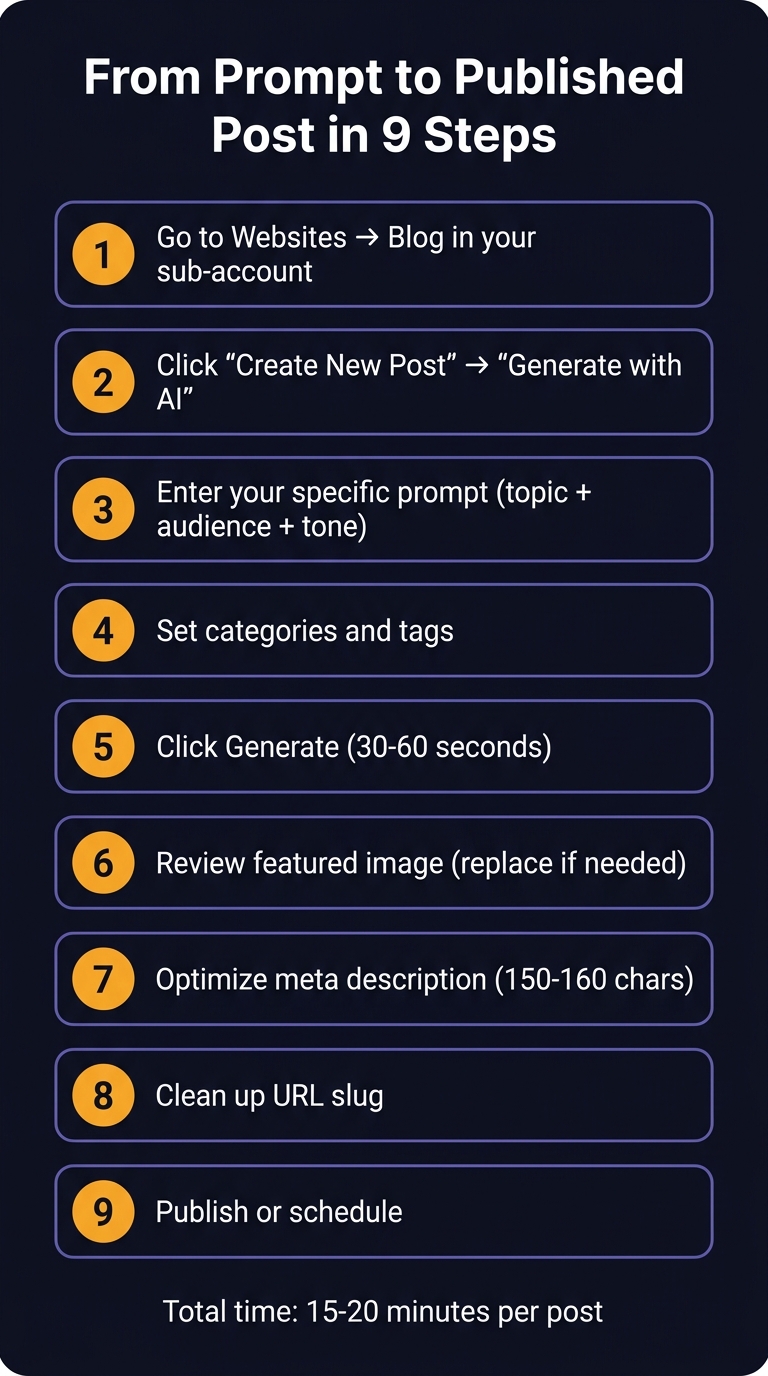
Step 1 -- Go to your sub-account → Websites → Blog. If you don't have a blog set up, create one first (5-10 minutes). You'll need a domain connected.
Step 2 -- Click "Create New Post" → "Generate with AI." Opens the AI blog writer modal.
Step 3 -- Enter your prompt. Use the format above. The more specific your topic and audience, the better the output. "Write a mortgage blog post" produces generic content. "Write a blog post about FHA vs. conventional loans for first-time buyers in a high-cost market" produces something useful.
Step 4 -- Set categories and tags. HighLevel suggests these automatically. Review and adjust. Categories and tags help organize your blog and support on-page SEO structure.
Step 5 -- Click "Generate." Full draft in 30-60 seconds. Review time: 5-10 minutes for a light pass, 20-30 minutes for thorough editing.
Step 6 -- Review the featured image. AI-generated images are inconsistent. Sometimes they're clean and relevant; sometimes they miss badly. Options: use as-is, swap for a stock photo (Unsplash and Pexels are free), or generate a custom image and upload it.
Step 7 -- Optimize the meta description. HighLevel auto-generates one. Verify it's 150-160 characters and accurately represents the post. This is what shows in Google search results -- it directly influences click-through rate.
Step 8 -- Set the URL slug. Auto-generated slugs are often messy. Clean it up: /blog/when-to-refinance-debt-consolidation instead of whatever the system generates with symbols or dates.
Step 9 -- Publish or schedule. If you're building a content calendar, the schedule feature lets you queue posts at a set date and time.
What to Watch Out For
AI images are inconsistent. Always preview before publishing. When in doubt, replace with a real photo. Stock images almost always look better than AI-generated images on mortgage content.
The AI doesn't know your local market. Generic content ranks, but local content ranks better. Add your city and state wherever it fits naturally: "when to refinance in Boise, Idaho" will outperform the generic version for local searches.
On-page optimization is still your job. HighLevel handles title, meta, and URL. Check that your primary keyword appears naturally in the first paragraph, at least one subheading, and the conclusion. Don't force it -- but don't ignore it.
Consistency beats volume. One post won't build organic traffic. A library of 30-50 well-written posts on topics your borrowers search for will. Set a sustainable goal: one post per week for six months. With HighLevel's AI writer, that's achievable in under two hours a week.
10 Mortgage Topics to Start With
Not sure what to write about? These have real search volume and work well with this workflow:
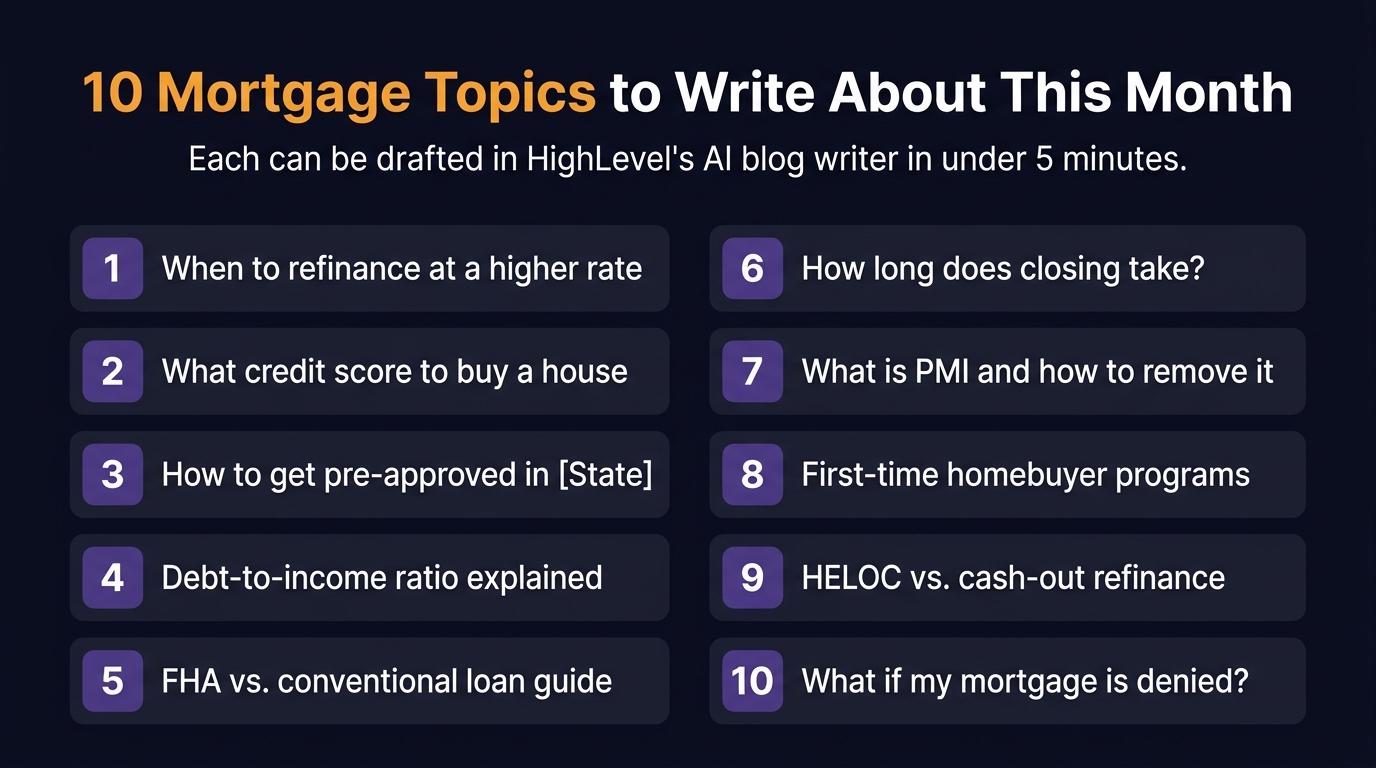
- When does it make sense to refinance at a higher rate?
- What credit score do I need to buy a house?
- How to get pre-approved for a mortgage in [State]
- Debt-to-income ratio: what it is and how to improve it
- FHA vs. conventional loan: which is right for you?
- How long does it take to close on a house?
- What is PMI and how do you get rid of it?
- First-time homebuyer programs in [State]
- How to use home equity: HELOC vs. cash-out refinance
- What to do if your mortgage application is denied
Key Takeaways
- HighLevel has a built-in AI blog writer that generates a full post, meta description, excerpt, and featured image from a single prompt.
- It runs on Claude Sonnet -- the writing quality is strong enough that most drafts need only light editing.
- The right prompt matters. Specific topic + defined audience + word count target produces significantly better output than a vague request.
- Local market context improves rankings. Generic mortgage content ranks, but geographically specific content ranks better for local searches.
- One post per week is sustainable with this workflow and builds a compounding SEO asset over time.
Frequently Asked Questions
Is the HighLevel AI blog writer free?
It's included in your HighLevel subscription. There may be AI credits usage limits depending on your plan and reseller configuration. Check your sub-account settings under AI tools to see your current usage.
Can HighLevel post blogs directly to WordPress or other platforms?
No -- HighLevel's blog feature publishes to your HighLevel-hosted website. It does not currently sync to external CMS platforms like WordPress. If your website runs on WordPress, you'd need to export the content and publish manually.
Do I need an SEO tool in addition to HighLevel?
For basic SEO (on-page optimization, meta tags, URL structure), HighLevel handles it adequately. For keyword research and competitive analysis, external tools like Ahrefs, SEMrush, or DataForSEO provide insight that HighLevel doesn't. Many LOs start with HighLevel's built-in tools and add keyword tools as their content program matures.
How many blog posts do you need before seeing SEO results?
SEO results typically begin appearing in Google Search Console within 3-6 months of consistent publishing. For competitive mortgage terms, expect 6-12 months before significant organic traffic. Less competitive local terms (e.g., "FHA loans [City, State]") can rank faster. Consistency matters more than speed.
The Bottom Line
Mortgage SEO is a long game. But with HighLevel's AI blog writer, the entry cost for playing that game dropped dramatically. What used to require a content team or a VA now takes one LO 20 minutes per week.
The mortgage professionals who start building their content library now will have a meaningful organic traffic advantage by the end of 2026. The ones who wait are giving that ground away for free.